If you have read my reviews for any length of time you will know that one of my many film bias is an extreme dislike of talking animals in my movies. Generally, they creep me out and take me right out of the experience. The one exception to that rule was The Chronicles of Narnia. I didn’t think that was a perfect film, but I liked it well enough to go and read all of the books. I always thought Prince Caspian was a pretty weak book. It was too short, the lead character Prince Caspian (Ben Barnes) was a whiney little #$## who didn’t do much in it, but the book’s biggest sin was it didn’t really delve into what it must of been like for the Pevensie kids – High King Peter Pevensie (William Moseley), Edmund Pevensie The Just (Skandar Keynes), Lucy Pevensie – The Valiant (Georgie Henley) and Susan Pevensie (Anna Popplewell) adjusted to the idea that they were adult Kings and Queens trapped as powerless 13 – 16 year old children. The book missed an opportunity to explore this dichotomy. When we first see the Pevensie kids we see how they are adjusting – not well. Peter is getting into fights over the most minor slights and it’s up to Edmund to protect his back. And that’s the beautiful thing about this movie – it’s how the Pevensie family has become so close to each other and wise. In the first film they were typical one dimensional kids and the kid actors were clearly out of the element.
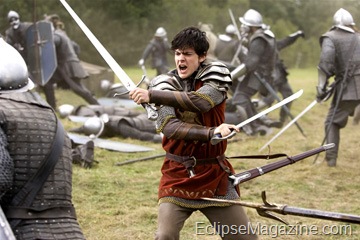
Here, they are very self aware and self assured as both actors and characters. There are times when you watch this movie where you can really see the duality of their personalities. You get that yes while they may look like kids, they truly are the former great Kings and Queens that they once were. It’s in their eyes, the way they move, and how they act. These kids could never had pulled this complexity of emotion off in the first film, but here it’s as if they were born to play these parts. The change in Edmund and Susan are the most pronounced. Edmund is a bad ass, calculating warrior that will do anything to protect his family, especially his brother Peter. While Susan has grown to be quite the fighter herself, the camera loves her and director Andrew Adamson showcases her perfectly, especially during the sweeping battles. When Susan breaks out the bow and arrow it’s a thing of beauty and pleasure to watch. As far as the animals go, I had the biggest concern for the noble mouse Reepicheep, I didn’t care for his character in the book, but he’s great in the film.
In one of our many emails, I think Sheldon summed up why Caspian works so well the best – it’s because the filmmakers chose to “make Caspian, naïve, rather than whiney.” And that subtle change makes all the difference in the world. Caspian comes across as stronger in the movie, more pro-active, not someone who just let’s things happen to him. He’s also self-involved at the most inopportune times. I like the fact that the film really played up the rivalry between Peter and Caspian. In the book Caspian just let Peter do everything without complaining or standing up for himself. Here Caspian calls Peter on his sometime “arrogance.” The writers Andrew Adamson (screenplay), Christopher Markus (screenplay), and Stephen McFeely took the best of C.S. Lewis’ work and expanded it to make it better. It’s a shame that Peter and Susan won’t be in the next film, because they will be missed. Everything about Prince Caspian is just right in terms of cinematography, scope and vision; the tone is dark but hopeful, and epic but intimate. While watching the battle scenes, the only thought going through my mind was, I hope the final Harry Potter film is a 10th as good as this was – . Bring on Eustace and Dawn Treader!
Final Grade A
EM Review by
Michelle Alexandria
Originally posted 5.17.08